
 My name is Matt Rafalow and I am a Sociologist (PhD, University of California-Irvine), a social scientist at Google, and a Research Fellow at University of Southern California’s Annenberg School for Communication and Journalism. At USC, I co-direct the Annenberg Creator Research Network (ACoRN). At Google, I manage a research team studying new experiences on YouTube (live streaming, gaming, and community). I strive to conduct research that blends academic inquiry with applied solutions that have a meaningful impact.
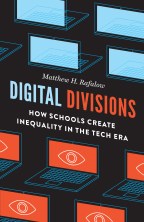
Most of my publishing is on education. In Digital Divisions: How Schools Create Inequality in the Tech Era (University of Chicago Press, 2020), I studied how digital technologies are used in middle schools. I found that teachers draw on organization-level understandings of student race and class to construct students as either risky hackers or Steve Jobs potentials. Digital technologies were not magic bullets to address educational inequities – rather, teachers adopted very similar technologies quite differently depending on the race and class of their student body. I am delighted to share that Digital Divisions is an award-winning book: it received the 2021 Best Book Award from the American Sociological Association’s Communication, Information Technology, and Media Sociology Section, and an honorable mention for the Sociology of Education Section’s 2022 Pierre Bourdieu Award.
In addition to my applied research at YouTube, I also study YouTubers and their viewers from an academic lens. In this new book project, I draw on the largest and most comprehensive mixed methods dataset of YouTube content creators and viewers to date. The dataset consists of interviews and surveys with YouTubers (ranging from 2,000 to 22 million subscribers) and their viewers to document the influence and impacts of audiences on what YouTuber content creators make and share with the world. These materials lead me to build on theoretical perspectives of art worlds that deemphasize the role of audiences in cultural production in this digital era. Instead, I document audience conventions that shape YouTubers’ content production in patterned ways.
If you’re curious as to what a sociologist does in the tech industry, see this little writeup I put together. If you’re a social scientist with interests in digital technology you should consider joining a 2000+ online community I co-created with like-minded folks.
 matt rafalow